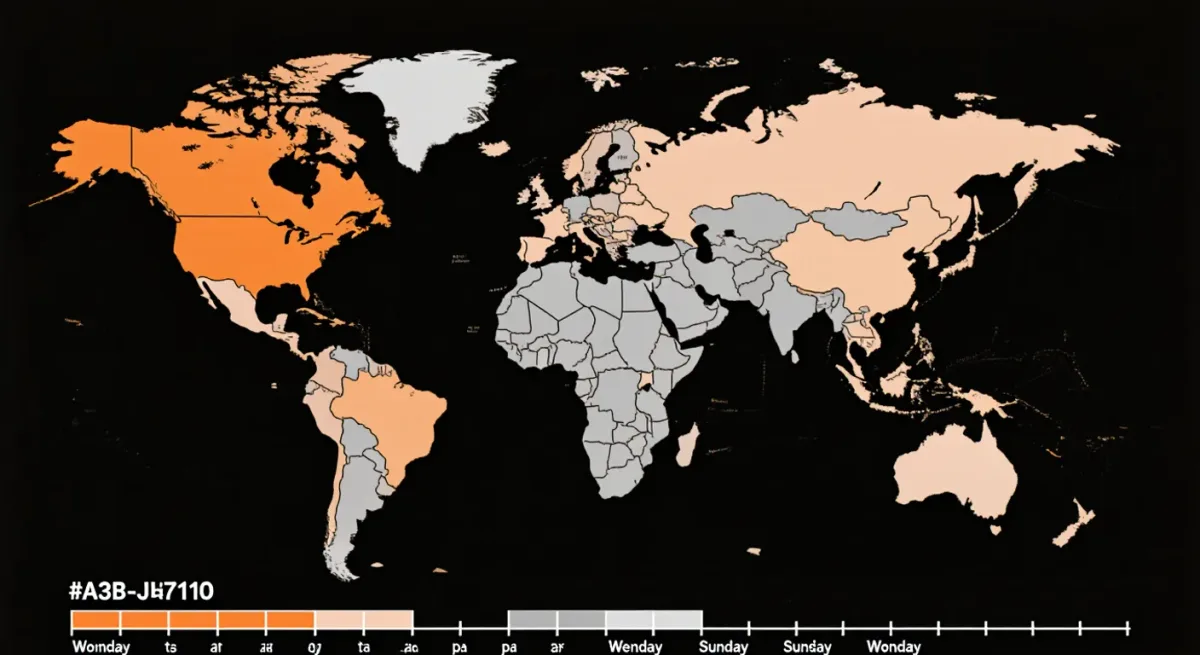
The Middle East and North Africa runs on three weekend patterns at once. Most of the Gulf, plus Egypt, Jordan and Iraq, rests Friday and Saturday. The UAE, alone among Gulf states since January 2022, rests Saturday and Sunday, as do Morocco, Algeria and Tunisia. And a layer of exceptions, half-day Fridays, bank-specific weeks and experimental four-day pilots, sits on top of both blocks. The pattern is the visible residue of each state's answer to one question: align with the global financial week, or protect the congregational Friday.
The Friday-Saturday bloc
Saudi Arabia set the modern template. In June 2013, a royal decree moved the kingdom's official weekend from Thursday-Friday to Friday-Saturday, effective June 29 of that year, explicitly to gain overlap with global markets: a Thursday-Friday weekend left Saudi institutions with only three shared business days with the West and none with East Asia's Monday openings. Oman had made the same move weeks earlier, effective May 1, 2013. Bahrain completed the set in 2022, shifting its public sector to Friday-Saturday from August 1 of that year, notably over the recorded objection of tens of thousands of employees consulted in a government survey. Qatar, Kuwait, Egypt, Jordan and Iraq rest Friday-Saturday as well, giving the crescent from Doha to Cairo to Baghdad a shared rhythm.
The logic of Friday-Saturday is straightforward: Friday is the day of congregational prayer and the region's true weekly anchor, and Saturday closes the week beside it. The cost is one lost business day with Western counterparties, since Gulf institutions work Sunday through Thursday while New York and London work Monday through Friday.
The UAE's 2022 break with the bloc
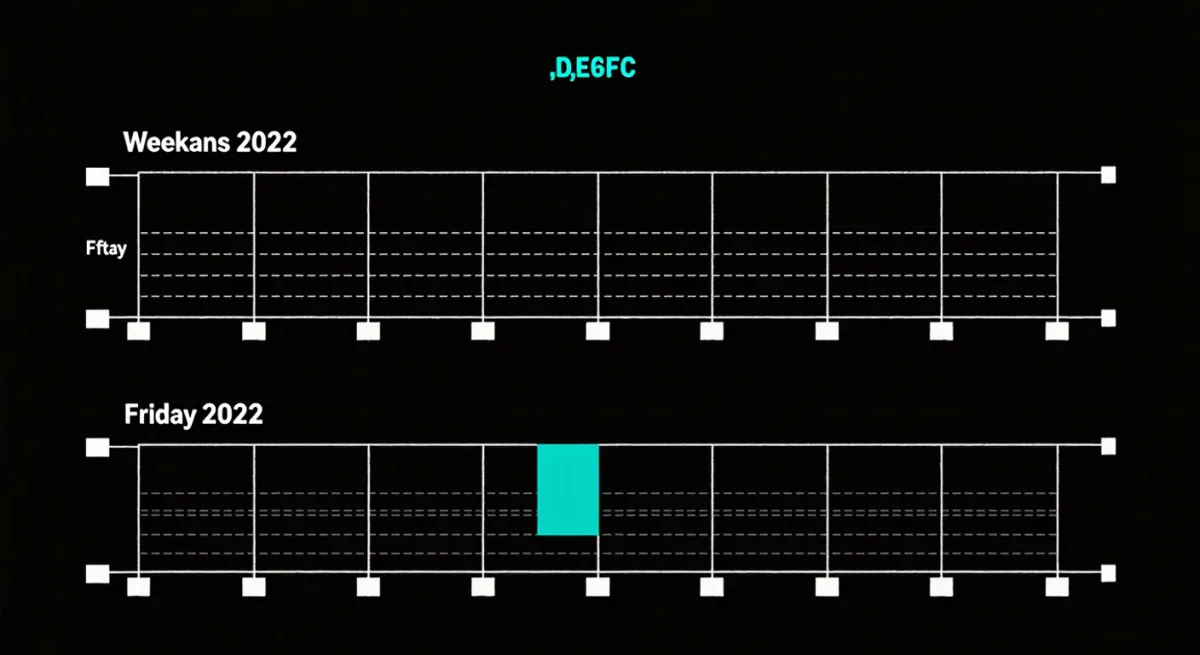
The UAE went the other way. Announced in December 2021 and effective January 1, 2022, the federal government moved the public-sector weekend to Saturday and Sunday and introduced a four-and-a-half-day working week, with Friday afternoons off for the congregational prayer, later relaxed as employers settled arrangements. The UAE framed the change as market alignment: with a Monday-morning start, the emirates share a full five-day overlap with global trading and logistics counterparts, and the change landed as the country marketed itself as the region's base camp for international business. Sharjah, one of the emirates, went further and trialed a four-day week for its public sector.
| Country | Official weekend | Changed when |
|---|---|---|
| UAE | Sat-Sun | January 1, 2022 |
| Saudi Arabia | Fri-Sat | June 29, 2013 |
| Oman | Fri-Sat | May 1, 2013 |
| Bahrain | Fri-Sat (public sector) | August 1, 2022 |
| Qatar, Kuwait | Fri-Sat | Long-standing |
| Egypt, Jordan, Iraq | Fri-Sat | Long-standing |
| Morocco, Algeria, Tunisia | Sat-Sun | Long-standing |
The Maghreb runs on the European week
North Africa west of Egypt never had the question. Morocco, Algeria and Tunisia, whose economies bind tightly to European markets through trade, migration and time zones one hour behind Central Europe, rest Saturday and Sunday, and their institutions work a straightforward Monday-to-Friday week. Lebanon, with its historically Mediterranean-facing commerce, does the same. This makes the practical oddity of the region's map: a Casablanca bank and a Dubai bank now share the same weekend, while a Casablanca bank and its Rabat-based government ministries share it too, but a Casablanca-Doha pairing loses the Sunday overlap in one direction only.
What it means in practice
The splits tax cross-border work, and the region's professionals have developed standard workarounds. Thursday is the new Friday for scheduling anything that needs both Gulf and European participants: the Gulf side is on its last workday, and the European side still has Friday spare. Sunday is the Gulf's catch-up day with Asia-Pacific. Regional organizations headquartered in Cairo or Riyadh staff Sunday desks; those in Dubai or Tunis don't need to. Stock exchanges encode the pattern, with Gulf markets trading Sunday-Thursday, the UAE markets now Monday-Friday, and North African bourses on the European calendar.
For travelers the pattern matters less, since retail and hospitality in tourist economies run seven days, but government services, banks and dry cleaners do not: a passport renewal in Muscat needs a weekday that is not Friday, and a notary in Rabat will not see anyone on Sunday. The practical rule for the whole region is to check the specific institution, because the exceptions, banking weeks shifted one day, free zones on Dubai's calendar inside Fri-Sat countries, and half-day Fridays across the UAE public sector, are common enough that the map is a starting point rather than the answer.
The calendar continues to move in small steps rather than large ones: Oman's 2023 labour law guaranteed two rest days per week for private-sector workers, up from one, and four-day-week pilots surface periodically in Gulf public sectors without changing the underlying weekend identity of any state so far.
Stock exchanges and the Friday problem
Financial markets encode the weekend map most visibly. Gulf bourses, Saudi Arabia's Tadawul, Qatar's exchange, Kuwait's, Bahrain's, Oman's and Egypt's EGX, trade Sunday through Thursday; the UAE's ADX and DFM now open Monday to Friday after the 2022 switch; and North Africa's Casablanca, Algiers and Tunis exchanges run the European week. The consequence is a five-day global trading week in which the region's markets are never all open at once, and index providers, custodians and ETF arbitrage desks program around the gaps as routine plumbing. The derivatives and clearing houses that settle across the region carry the same calendar seams. For retail investors, the practical effect is simple: a global headline that lands on a Friday moves the Maghreb and UAE markets on the same day, while the rest of the Gulf prices it on Sunday, and the weekend arbitrage that follows is one of the region market's quiet regularities, watched more by algorithmic desks than by anyone else.
For more on the structures under the region's working life, see our explainer on what remains of the Gulf's kafala sponsorship system, and browse the society and culture section.