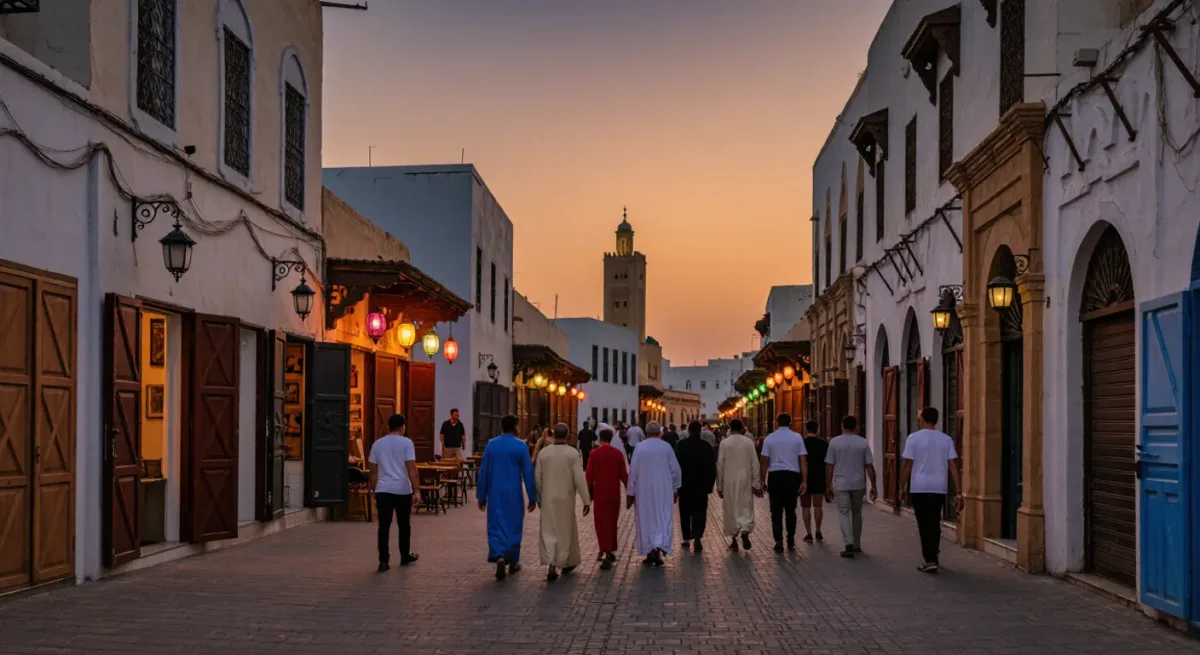
Across the Middle East and North Africa, the loudest clock is not on a wall. Five daily prayers, Fajr before dawn, Dhuhr just after midday, Asr in the late afternoon, Maghrib at sunset and Isha at nightfall, are calculated from the sun's position and announced by the call to prayer, the adhan, from every mosque in earshot. The times shift by a minute or two each day with the seasons and differ by latitude, which is why every city publishes its own schedule.
The five prayers are the fixed pillars of the day's rhythm. Fajr falls in the dark before sunrise, and in Gulf cities its adhan is the practical signal that the pre-dawn meal window has closed during Ramadan. Dhuhr sits just past solar noon, and on Fridays it expands into the congregational prayer with a sermon, the khutba, which is the week's main communal event. Asr lands mid-afternoon, Maghrib immediately at sunset, and Isha an hour or so after. Between them, the day is not paused; the prayers are short, and the rhythm they create is one of orientation points rather than interruptions.
Who sets the times, and why they differ
Prayer times are astronomical, computed from the sun's angle relative to the horizon, but the exact thresholds are set by convention, and the conventions differ. Saudi Arabia's official times follow the Umm al-Qura calculation, whose Isha threshold runs earlier than the formula used in, for example, Pakistan or Turkey. Egypt's survey authority publishes its own tables, Morocco's Ministry of Endowments publishes times used by mosques nationwide, and Gulf states publish through their Islamic affairs ministries. The practical consequence for travelers is that prayer-time apps ask for a calculation method on first setup, and a Kuwait timetable will not match a Rabat one even on the same day. In high-latitude European cities the formulas need patches; in MENA, between roughly 35 degrees north and the tropics, the sun does the scheduling cleanly year-round.
What actually changes on the street
Effects vary sharply by country and district. In Saudi Arabia, shops in older souks traditionally close through the prayer interval and reopen immediately after, while malls and airports stay open, with worshippers moving to their prayer rooms; the strict closure custom has loosened in the big cities but survives in provincial retail streets. In Egypt, Morocco, Tunisia, Jordan and Lebanon, commerce runs through prayer times uninterrupted, and the adhan functions as ambient punctuation. Everywhere, Friday midday is the closest thing to a regional Sunday morning: government offices are closed by definition of the weekend, mosques fill, and the sermon, broadcast on state radio and television in most countries, is a matter of public record and occasional political news.
| Prayer | Timing | Practical marker |
|---|---|---|
| Fajr | Pre-dawn | End of the Ramadan night meal |
| Dhuhr | Just after midday | Friday sermon replaces it weekly |
| Asr | Late afternoon | School and work breaks in the Gulf |
| Maghrib | Sunset | Fast-breaking moment in Ramadan |
| Isha | Nightfall | Night prayers in Ramadan follow it |
Ramadan changes the stakes
During Ramadan the timetable becomes the month's organizing grid. The dawn adhan closes eating; the sunset adhan, not a clock time, opens the fast, which is why Ramadan calendars in the region print both adhan-based times and the day's fasting duration. The last ten nights add tarawih prayers after Isha, keeping mosques and surrounding streets active past midnight, and Eid is declared when the new moon is confirmed, making the calendar's biggest dates moon-dependent. Ramadan's migration through the solar year, 11 days earlier annually, currently lands it in late winter, which has shortened fasting hours toward their regional minimum after the long midsummer fasts of the mid-2010s.
For visitors and new residents
- Prayer rooms: malls, airports, universities and office towers across the Gulf maintain segregated ablution-equipped rooms; in the Maghreb and Levant, mosques themselves are the facility.
- Friday planning: schedule nothing official between roughly 11:30 a.m. and 2 p.m.; traffic peaks before and quietens during the sermon.
- Apps: prayer-time applications default to the national calculation method when location services are on; the timetables also publish in every newspaper's back pages.
- Courtesy: non-Muslims are welcome to observe mosque prayers from designated areas; shoes off, phones silent, and no walking in front of worshippers.
Calculation methods, in plain terms
The conventions differ at the day's edges. Fajr is timed by the sun's depression below the horizon before dawn, and the thresholds vary: 18 degrees in the standard method, 18.5 in the Muslim World League's, 19 in one Egyptian formulation, while Saudi Arabia's Umm al-Qura calendar uses a shallower angle that produces an earlier Fajr and a later Isha than its neighbors' tables. Isha depends on the disappearance of twilight, with the same divergence, and in high latitudes, where twilight can last all night, the methods need patches that Middle Eastern latitudes never trigger. For travelers crossing the region, the practical rule is that the apps ask for a method on setup because the national timetables disagree by ten to twenty minutes at dawn and nightfall while agreeing almost exactly on the midday prayers. Friday's congregational timing adds the khutba's variable length, which is why Friday lunch plans shift week to week and why the sermon's broadcast slot, fixed on national radio, runs long without apology.
The system is one of the region's genuine public commons: a shared, audible, citywide time signal older than any clock tower. For another look at how the region's shared rhythms are set, read our guide to following the Saudi Pro League, or browse the society and culture section.