How do working hours change during Ramadan? In the Gulf states, labor statutes mandate a reduction of two hours per day for fasting Muslim employees without a pay cut, and public sectors often go further, moving to compressed morning-only schedules. Across the wider region, schools shorten their days, offices shift earlier, and the working rhythm of the month reorganizes around the sunset break of the fast.
The legal baseline in the Gulf is explicit. The United Arab Emirates' federal labor law reduces maximum working hours for fasting employees during Ramadan from eight to six per day, and the equivalent provisions in Saudi Arabia, Qatar, Kuwait, Bahrain and Oman cut the daily maximum by two hours for Muslims observing the fast. The reduction applies to the standard working week, meaning a 48-hour week becomes 36 hours for those employees, and overtime rules price hours beyond that ceiling accordingly. Non-Muslim employees are formally outside the fasting reduction in several of these frameworks, though many workplaces apply schedule changes across the board.
Public sector schedules
Public sectors run shorter still. Gulf ministries commonly publish Ramadan hours that cluster between 9 or 10 a.m. and 2 or 3 p.m., Sunday or Monday through Thursday, with the weekend unchanged. Egypt's public offices historically shift to earlier starts, and Jordan, Morocco and Tunisia announce adjusted hours annually through civil-service decrees. Schools across the region shorten the instructional day, and exam calendars are typically built to keep national examinations away from the month or to schedule them in the morning, when students who are fasting are freshest.
| Country | Fasting employees, private sector | Typical public-sector pattern |
|---|---|---|
| UAE | 2-hour daily reduction | Compressed day, early close |
| Saudi Arabia | 2-hour daily reduction | Morning-only hours common |
| Qatar, Kuwait, Bahrain, Oman | 2-hour daily reduction | Compressed day |
| Egypt | Reduced hours by decree for Muslims | Earlier start, shortened day |
| Jordan, Morocco, Tunisia | Varies by sector | Announced annually |
The shape of the working day
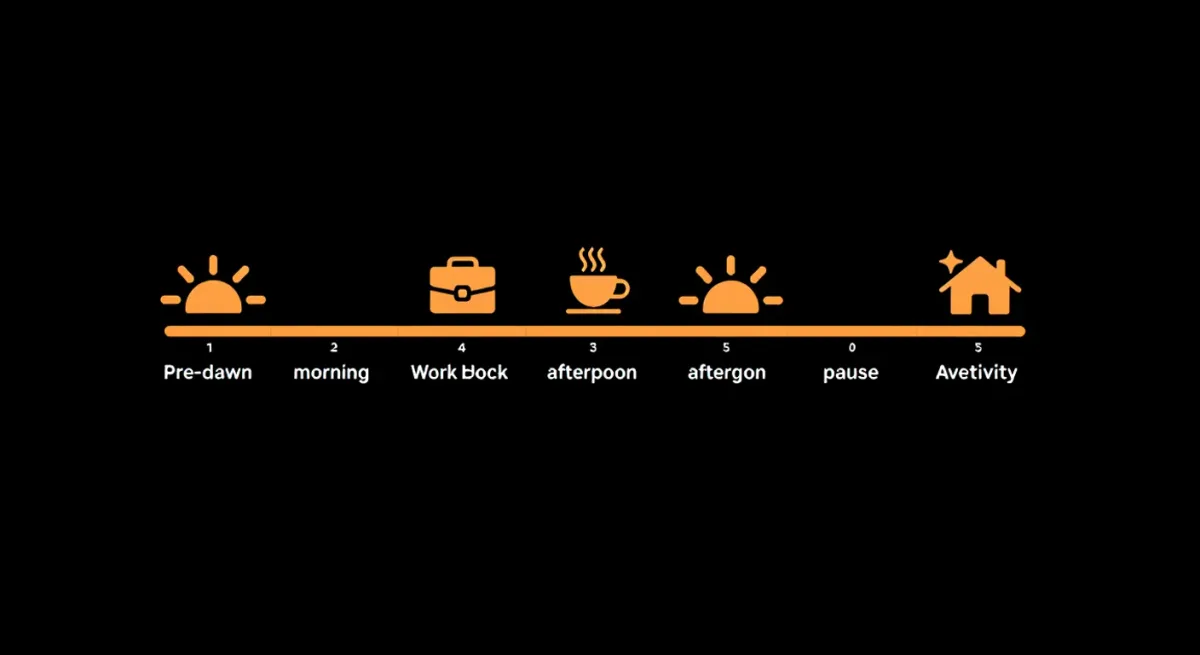
The legal reduction is only half the practical picture. The month's rhythm reorganizes around two fixed points, the pre-dawn meal and the sunset fast-breaking, iftar, and the productive hours shift accordingly. In Gulf business hubs, a common pattern moves meetings into the late morning, pauses activity in the mid-afternoon and revives work after the evening meal for sectors that run evening operations. Restaurants in the Gulf's more conservative jurisdictions close through daylight hours or screen their service; in Egypt, Morocco, Lebanon and Tunisia, many restaurants open through the day in tourist and business districts, with alcohol service restricted in some jurisdictions for the month.
Two daily frictions recur for visitors and new arrivals. The first is the late-afternoon quiet: from roughly an hour before sunset, government offices have closed, delivery schedules thin, and traffic builds toward peak as households converge on the iftar table, and the period between the call to prayer and an hour after it is the quietest traffic window of the regional day. The second is the post-iftar surge: retail, cafes and public spaces fill from the evening meal past midnight, malls extend hours, and the week's economic center of gravity moves to the night, particularly in the last ten days of the month.
Ramadan dates, year by year
Because the Islamic calendar runs about 11 days shorter than the solar year, Ramadan migrates through the seasons on a 33-year cycle. In 2026, the month is expected to begin around February 18 and end around March 19, with Eid al-Fitr falling around March 20, subject to moon sighting. Each year the start moves about 11 days earlier on the Gregorian calendar, so within a decade the month will sit in deep winter across the Northern Hemisphere, with shorter fasting days, a shift that already changed the labor-market experience of the fast compared with the long midsummer days of the mid-2010s in the other direction of the cycle.
What visitors and business travelers should plan for
- Eating in public: laws vary. Several Gulf jurisdictions restrict public daytime eating for everyone; in most Levant and Maghreb countries it is legal though discreet. Check the specific emirate or country.
- Meetings: schedule before 2 p.m.; expect cancellations in the final hour before sunset.
- Eid al-Fitr: public holidays of two to four days follow the month, with government closures and heavy domestic travel; the holiday is a paid public holiday everywhere in the region.
- Courtesy basics: greetings of Ramadan kareem are standard; accepting iftar invitations is a normal business courtesy; dress codes tighten slightly in public spaces.
- Service industries: hotels and airports operate normally; airline schedules run full but on time; tourist sites keep shorter hours in several countries.
How the hours differ across the region
The reduction's mechanics vary more than the principle. In the UAE, the labour law's Ramadan provision applies to Muslim employees in the private sector and is enforced through the wage-protection and inspection system; the public sector publishes its own shorter schedule annually. Saudi Arabia applies the two-hour reduction through its labor law and extends the public sector's shortened day by decree each year, with ministries typically running from around 10 to 3. In Egypt, reduced hours for fasting civil servants run by prime-ministerial announcement, and private-sector practice follows sector norms rather than uniform statute. Jordan, Morocco and Tunisia handle the month through administrative circulars and sectoral agreements. Across all of it, one rule of thumb holds for planning: from the pre-dawn meal to the mid-afternoon, expect full productivity; in the last two hours before sunset, expect very little; and after the evening meal, the region is more awake than at any other hour of the day.
The month ends with Eid al-Fitr as a paid national holiday across every MENA jurisdiction, and the return to full working hours follows immediately. For another calendar that reshapes the region's working life, read our explainer on Yennayer, the Amazigh New Year, and see the society and culture section for the rest of the region's rhythms.