Energy cooperatives are businesses owned by the people who use them. Members buy electricity, heat, or financial services from an organisation they jointly own, and any surplus returns to them or is reinvested. The model covers two related structures: an energy cooperative that generates or distributes power, and a credit union — sometimes described in search results as an energy credit union when it finances solar panels or efficiency upgrades — that lends to members at cost.
The popular assumption is that member ownership means cheaper bills by definition. That is only partly true. A cooperative removes the shareholder profit margin, but it still has to pay for fuel, maintenance, staff, and borrowed money. Where those costs are high, a cooperative's prices are high too. The real difference is in control and purpose: the surplus goes back to members rather than to outside investors.
Understanding, in the dictionary sense of the ability to grasp how something works, is the first requirement for anyone weighing the model, and the definition of understanding as comprehending a concept well enough to make informed decisions fits the choice facing a household or a village deciding whether to co-fund its own power supply. This explainer sets out how the structures work and who they serve best.
What is an energy cooperative?
An energy cooperative is a legal entity in which members — households, farms, or small businesses — hold shares and vote on decisions, usually on a one-member, one-vote basis rather than in proportion to capital. Typical activities include operating a small generation plant such as a wind turbine or solar array, running a local distribution network, or buying fuel in bulk for a heating scheme. The cooperative's constitution usually requires any surplus to be returned to members, held in reserve, or reinvested in the asset.
The one-member, one-vote rule matters more than it first appears. It prevents a large investor from taking control, which is why cooperatives tend to survive in places where residents want a say over local infrastructure. It also slows decision-making, which is a genuine cost when a project needs to move quickly or raise significant capital.
What is a credit union, and why does it appear in energy searches?
A credit union is a financial cooperative. Members pool savings, and the pool funds loans to other members. Because there are no outside shareholders, the union can price loans to cover costs rather than to generate profit, and it returns surplus to members as dividends on savings or lower rates. The phrase "energy credit union" usually describes a credit union that lends specifically for energy purposes: rooftop solar, insulation, heat pumps, or small community generation projects.
The financing link is where the two halves of the topic meet. An energy cooperative needs capital to build, and a credit union is one of the few lenders that will consider small, community-scale projects, because its members live in the same area and understand the local risk. In several countries, credit unions have become the default route for financing household renewables that commercial banks consider too small to bother with.
How does member ownership change the economics?
Three mechanics distinguish a cooperative from an investor-owned utility or bank.
- Surplus recycling. Profit is not extracted. It is either rebated to members, credited against future bills, or kept as reserves. Over time this compounds: reserves reduce borrowing needs, which reduces costs further.
- Patient capital. Members accept lower or slower returns than outside investors would demand. This makes long-payback projects — a district heating pipe, a small hydro plant — viable where a commercial developer would walk away.
- Trust-based lending. A credit union knows its borrowers. That local knowledge can substitute for collateral, letting households with thin credit files borrow for upgrades they could not otherwise finance.
None of this makes a cooperative immune to bad management. Governance depends on volunteers and elected boards, and small institutions can lack technical expertise. A cooperative that underprices its electricity to please members can run down its assets just as surely as a profit-hungry owner would.
Who do energy cooperatives serve best?
The model works best in three settings. The first is rural or remote communities far from dense commercial markets, where a single shared asset — a mini-grid, a wind turbine, a biomass boiler — serves a village that no utility finds profitable. The second is communities with strong social cohesion, because member ownership relies on people attending meetings, serving on boards, and accepting collective decisions. The third is households excluded from mainstream finance, for whom a credit union's local knowledge and low-cost structure open lending that banks decline.
The model fits poorly where scale is the binding constraint. National grids, large gas-fired plants, and utility-scale solar need capital and technical management far beyond what a membership can supply. That is why the large energy buildout across the Gulf and North Africa — the utility-scale solar auctions, the cross-border interconnection projects covered in Sala News's energy section — is being financed by states and large investors, not cooperatives. Member ownership is a complement to that buildout, not a substitute for it. Readers following this should also see Solar Energy Middle East — Renewables in the Gulf: Solar's Quiet Buildout Reshapes Oil Economies.
Where does the model fit in the Middle East and North Africa?
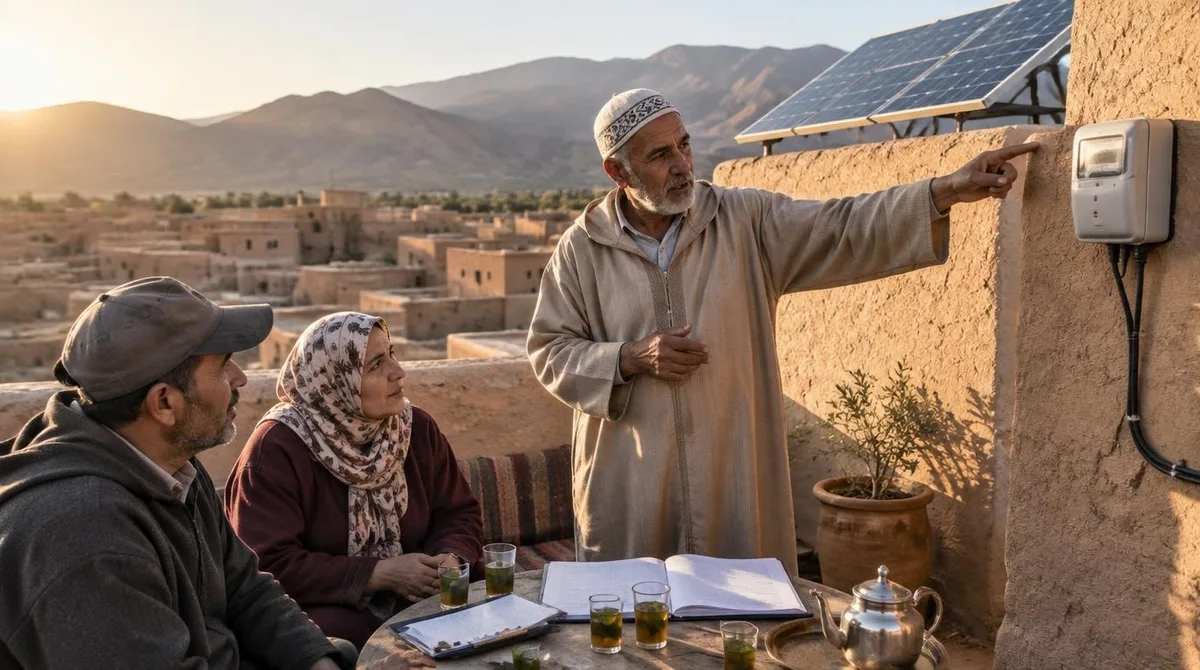
In the MENA region, cooperative energy remains marginal at grid scale, but the underlying logic is familiar. Village and agricultural water-user associations, agricultural marketing cooperatives, and mutual-aid savings groups have long histories in Egypt, Morocco, and the Levant. The same institutional instincts — pooled resources, local control, mutual guarantee — transfer to small energy projects: a shared solar array for an irrigation pump, a credit circle financing rooftop panels, a village mini-grid where the national grid has not reached.
Regional electricity systems are dominated by state utilities, and price subsidies shape household decisions in most markets, which limits the space for member-owned alternatives. But two pressures could widen it. Falling solar costs make small distributed generation more affordable than ever, a trend Sala News tracks in its coverage of solar's buildout across the Gulf. And the region's recurring peak-demand squeezes, examined in coverage of supply, demand and prices, push governments to look for any mechanism that trims consumption at the household level. Community ownership and cooperative financing are among the tools that can do that, where regulation allows grid connection and net metering. This connects to our earlier piece, The Gulf's solar mega-projects: who is building what, and at which prices.
The practical test for any community considering the model is unglamorous: can the group secure a legal form, a connection agreement, and honest technical advice? Institutions matter more than enthusiasm.
What this means for households and communities
Member ownership changes who captures the value of energy and finance, not the physics of generating it. For a household, the practical questions are straightforward. Is there a cooperative or credit union operating locally, and is it regulated? What does membership cost and what voting rights does it carry? How does the institution recycle surplus — rebates, dividends, or reserves? And for any energy project, who supplies the technical expertise, because a cooperative is only as sound as the engineering behind it.
The honest verdict is that cooperatives and credit unions are neither a panacea nor a niche curiosity. They are a proven ownership structure that suits small, local, patient projects and underserved borrowers, and they fit badly where scale, speed, or subsidy dominate. Communities that match the model to the right-sized problem tend to get exactly what member ownership promises: control, and a fair share of the surplus.