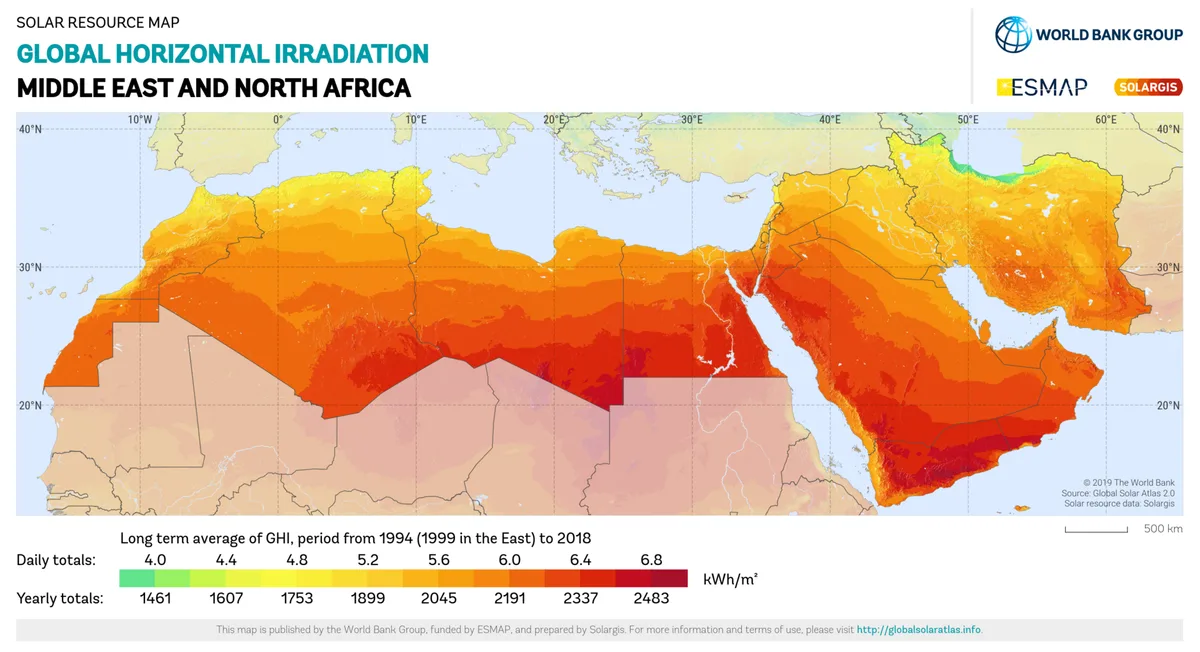
The popular assumption is that Gulf oil producers have little reason to push solar energy. Middle East renewables, on this view, are a public-relations exercise bolted onto economies that live off crude. The evidence runs the other way. Solar power is now, in many places, the cheapest new-build electricity available, and the Gulf sits under some of the most reliable sunlight on the planet with cheap, flat land to build on. That combination makes the buildout a matter of economics, not image.
The shift is quiet because it does not announce itself the way an oil discovery does. A solar farm displaces gas that would otherwise be burned at home, and gas not burned at home can be exported. For Qatar and other producers, that trade-off is the whole story: every megawatt-hour of domestic solar frees a barrel-equivalent of fuel for the export market. The buildout reshapes regional energy portfolios precisely because it does not replace oil exports. It replaces domestic fuel burn. For related coverage, see Brent, Murban, OSPs: how Middle East oil is actually priced.
The global context helps explain the timing. According to Wikipedia's renewable energy overview, renewables grew from 20 percent to 28 percent of global electricity supply between 2011 and 2021, with solar and wind driving most of that increase, and reached 34 percent of global generation in 2025. Solar and wind have seen steep cost reductions over the past decade, which is what made them competitive with traditional fossil fuels. Gulf utilities, which once burned cheap domestic gas with little thought of alternatives, now face a simple comparison: solar costs have fallen, while gas carries an opportunity cost tied to export prices.
Why are oil producers building solar at all?
Because it pays twice. First, solar panels have no fuel cost, so once a plant is built the electricity is essentially free to run, while a gas plant consumes a resource the state could sell. Second, domestic demand in the Gulf is heavy: air conditioning loads peak in the middle of the day, which is exactly when solar output peaks. The match between the solar curve and the demand curve is unusually good in hot climates, and that match reduces the need for expensive backup capacity.
There is also a fiscal logic. Governments that subsidize electricity for households and industry pay the difference between the cost of generation and the price charged. When the generation cost falls, the subsidy bill falls with it. A solar buildout is therefore partly a budget measure, not only an energy measure. That is the kind of mechanics-versus-claims reading the topic usually lacks: the driver is not climate diplomacy. It is the state's own balance sheet.
What is holding the buildout back?
Variable renewable energy, the term for sources that fluctuate with weather, includes both solar and wind. Solar stops producing at dusk, and Gulf air-conditioning demand runs well into the evening. Without storage or flexible backup, each additional solar plant delivers less value than the last. This is the classic diminishing-return problem of any variable source, and it sets a natural ceiling on how far solar can go before batteries or other flexibility become essential.
The same global picture flags the other constraints. According to Wikipedia's renewable energy entry, deployment still faces obstacles including fossil fuel subsidies, lobbying by incumbent power providers, and local opposition to land use. The Gulf version of that list looks different in detail but similar in shape: subsidized domestic fuel prices weaken the incentive to switch, incumbent utilities own the gas plants, and grid infrastructure was built around large central generators rather than distributed ones.
Grid connections are the quieter constraint. Solar plants work best when they can send power across borders or store it for later, and the region's grids were designed as national systems, not regional ones. Efforts to link them up change what a solar farm is worth: a plant that can sell surplus power to a neighbor at midday, or buy backup after dark, has more value than an isolated one.
How does this fit the oil business?
It fits as a hedge, not a replacement. The Gulf's export revenue still rests on crude, gas and the pricing systems around them, and readers who want the mechanics can follow how Middle East oil is actually priced. Solar changes the domestic side of the ledger. It reduces the fuel the producers burn themselves, which matters most for countries whose gas is committed to export contracts, and for those facing domestic gas shortages of their own. This connects to our earlier piece, The Gulf's solar mega-projects: who is building what, and at which prices.
It also connects to the next stage of the story. Several regional governments have framed solar buildouts as the foundation for green hydrogen production, using cheap midday electricity to split water. Most of those projects remain early-stage, and the gap between announced plans and financed projects is wide. Solar at home is real today; hydrogen for export is still mostly a proposal.
What does the global evidence say about the trajectory?
The direction of travel is clear even if the Gulf-specific numbers stay outside this article's evidence base. The International Energy Agency estimates, per Wikipedia's summary of the IEA's net zero analysis, that 90 percent of global electricity would need to come from renewables by 2050 to reach net zero emissions, and that the current pace of expansion falls far short of that rate worldwide. In some localities, photovoltaic solar or onshore wind is already the cheapest new-build electricity, and a large majority of newly installed generating capacity worldwide is now renewable.
For the Gulf, the relevant comparison is not with Europe's targets but with its own alternative: burning exportable gas at home. As long as gas has a market price and sunlight has none, the economics keep pointing the same way. The buildout will accelerate or stall depending on storage costs, grid links and subsidy reform, not on whether the region's governments like solar.
What this means for the region's energy portfolio
The practical picture is a portfolio shift, not a transition in the dramatic sense. Oil and gas remain the export engine. Solar steadily takes over the domestic generation that gas once supplied, freeing fuel and cutting subsidy costs. Storage and regional interconnection decide how far that substitution can run. The quiet buildout is quiet because it works through utility balance sheets rather than headlines, and that is also why it is likely to continue.
What remains unknown is the pace. The evidence assembled here establishes the global cost trend, the demand match and the structural obstacles. It does not settle how quickly individual Gulf states will add capacity, or when storage becomes cheap enough to lift the evening constraint. Those questions will be answered project by project, and the projects, unlike the assumptions, are already in the ground.