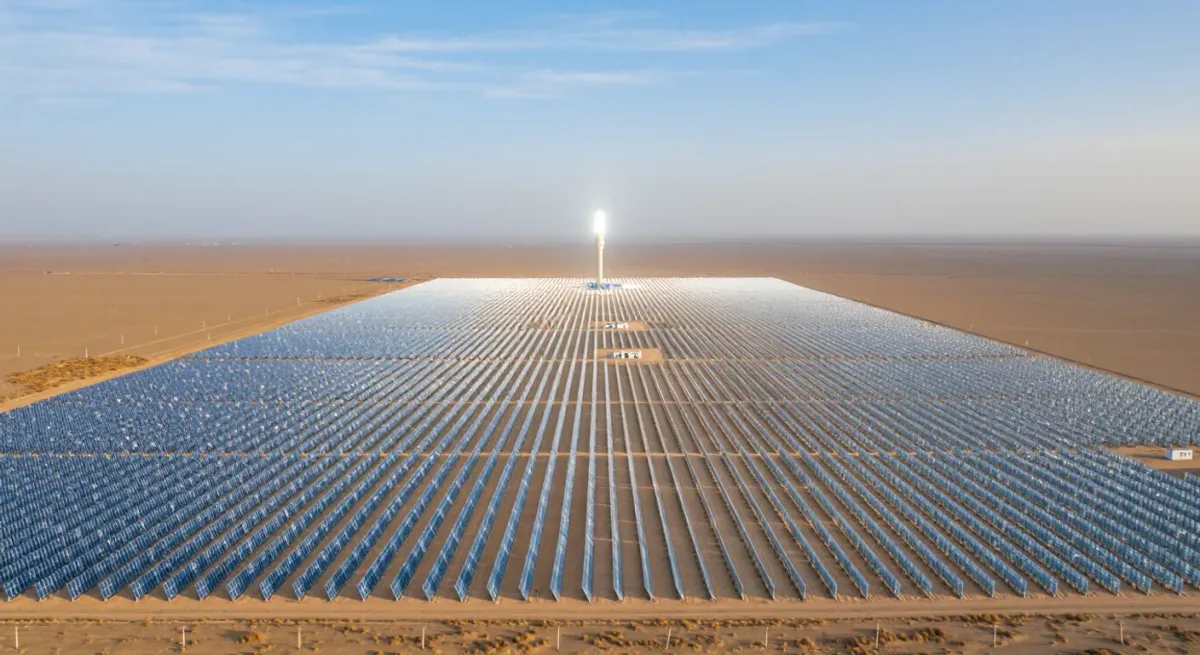
The Gulf's utility-scale solar program has produced some of the largest plants and lowest tariffs on record, built by state utilities in partnership with international developers bidding in competitive auctions. The core list is compact: Al Dhafra in Abu Dhabi at 2 gigawatts, the Mohammed bin Rashid Al Maktoum Solar Park in Dubai growing toward 5 gigawatts by the end of the decade, Saudi Arabia's Sakaka and Sudair complexes, Egypt's 1.65-gigawatt Benban park, and Morocco's Noor Ouarzazate complex with its landmark concentrated-solar towers. Together they explain how a hydrocarbon region became one of the world's cheapest solar markets.
Al Dhafra, Abu Dhabi
Al Dhafra, developed by Abu Dhabi's Emirates Water and Electricity Company with international partners, reached full operation in 2023-2024 and ranks among the largest single-site solar plants ever built, at 2 gigawatts and roughly 3.5 million panels on the desert southwest of the capital. The project's headline is its tariff: the winning 2020 bid came in near 1.32 US cents per kilowatt-hour, among the lowest solar prices ever contracted, and it set the template Gulf auctions have followed since, state-backed land and grid connections, international consortium competition, and 30-year power purchase agreements that let bidders price capital, not fuel.
Mohammed bin Rashid park, Dubai
Dubai's flagship, run by DEWA under the independent power producer model, is designed for 5 gigawatts by 2030 across a single solar corridor south of the city. Its phases mix technologies: conventional photovoltaic blocks, a concentrated solar power element with one of the world's tallest solar towers and molten-salt storage, and research and innovation centers. The park's auction results through successive phases fell from around 5.8 cents at the first phase, then remarkable for the region, to below 2 cents, tracking the global collapse in panel costs and Dubai's financing terms.
Saudi Arabia's build-out
The kingdom's program pairs utility-scale complexes with an industrial strategy. Sakaka, at 300 megawatts in the northern Al-Jawf region, was the flagship first project under the national renewable energy plan's auction rounds; Sudair, at 1.5 gigawatts north of Riyadh, followed as one of the region's largest single-award plants, with PIF-backed consortia pairing Saudi content requirements with international technology. The pipeline behind them, auctioned through the kingdom's renewable energy project office and scaled to tens of gigawatts, is the largest in the region, and the March 2026 reporting cycle has the kingdom at roughly nine gigawatts of renewables under construction with hydrogen and carbon-capture initiatives alongside.
| Project | Country | Capacity | Significance |
|---|---|---|---|
| Al Dhafra | UAE | 2 GW | Record ~1.32 c/kWh bid in 2020 |
| Mohammed bin Rashid park | UAE | 5 GW by 2030 | CSP tower plus PV phases |
| Sudair | Saudi Arabia | 1.5 GW | PIF-backed auction model |
| Benban | Egypt | 1.65 GW | 32-plot pioneer park |
| Noor Ouarzazate | Morocco | ~580 MW | World-scale CSP complex |
Benban and Noor: the wider region's anchors
Egypt's Benban, commissioned in the southern desert near Aswan by 2019, aggregated 32 project companies under a single grid connection and proved the region's second model: many developers, one park, standardized feed-in terms. It anchored Egypt's renewables ambitions until macro constraints slowed follow-on rounds, and the current pipeline, wind-heavy per the 2026 outlooks that put Egypt and Saudi Arabia together at the overwhelming share of forecast regional wind additions, is the next chapter. Morocco's Noor Ouarzazate, built across phases from 2016, combined photovoltaic and three concentrated-solar plants with thermal storage, its Noor III tower among the tallest of its type, and delivered the credibility that let Rabat contract subsequent solar rounds at conventional PV prices while targeting higher renewables shares in its mix.
Why the Gulf can bid so low
The tariff records have a specific recipe. Irradiance in the Arabian Peninsula is among the highest on earth, which raises the yield of every panel. State utilities provide the land, grid access and offtake guarantee, which strips development risk. Auctions attract consortia of international developers, Gulf sovereign funds and panel manufacturers who treat the bids as strategic positioning. And financing costs, the decisive variable in levelized tariffs, sit near sovereign rates for projects with state offtake. The result is not subsidy in the classic sense; it is risk allocation, and it has made solar the cheapest incremental electron in most Gulf states, freeing gas for export and industry.
What comes next
Three developments define the current phase. Storage is entering the auctions, with battery-paired rounds in Saudi Arabia and the UAE designed to shift evening peak supply onto daytime solar. Demand itself is the new variable, as data centers, desalination and hydrogen electrolysis become the loads that justify the next gigawatt tiers, and regional reporting through 2026 has electricity demand projections for the region rising by half by 2035 on that logic. And the localization question, where panels, inverters and mounting structures are manufactured, has moved from preference to policy, with Saudi content rules shaping consortium composition. The era of record-breaking single plants is maturing into an era of programmatic build-out, which is less photogenic and more consequential.
What the auctions ask of developers
Winning a Gulf solar auction is a discipline with known steps. The authorities, EWEC in Abu Dhabi, DEWA in Dubai, the Saudi energy ministry's REPDO and its PIF-track counterpart, package sites with grid connection dates, land and offtake already solved, which is why the bids can be so low: developers price execution risk and financing, not development risk. Consortium composition follows: an international developer for track record, a Gulf sponsor for balance-sheet and local content, frequently a module manufacturer equity partner whose product ships into the project. The bid itself is a levelized tariff against a multi-decade power purchase agreement with a state counterparty, and the competition's history, bids falling from five cents through two toward the record lows, has made each round a reputational event. Local content rules increasingly shape procurement of structures, installation labor and, in Saudi Arabia's later rounds, manufacturing. For the region's engineers and contractors, the auction calendar is the employment map, and for everyone else, each award's tariff is a public benchmark in the world's cheapest-power league table.
For the fuels-to-molecules side of the transition, read our guide to green hydrogen projects across MENA, and browse the energy section for the region's power markets.