Oman rewards the traveler who leaves Muscat with a car. The country's core circuit runs from the capital's mosques and souq through the fort towns of the interior, the flooded canyons of the eastern Hajar foothills and the green terraces of Jebel Akhdar, all within a week of driving on good roads. The basics up front: the October-to-March window suits the north, fort tickets generally run a few rials, wadis require attention to weather rather than technical skill, and Salalah in the far south runs on an entirely different monsoon calendar from June to September.
Muscat: the capital baseline
Muscat is a low-spread coastal capital between bare mountains and the Gulf of Oman, and its two anchor stops are the Sultan Qaboos Grand Mosque and Mutrah. The mosque opens to non-Muslim visitors on weekday mornings; it is free, and the dress code is enforced, with abayas and dishdashas lent at the entrance for those who need them. Mutrah Souq, the covered market behind the corniche, is a working gold, textile and frankincense market rather than a heritage performance, and the waterfront corniche walk to the old city gates takes under an hour. The twin Portuguese-era forts of Al Jalali and Al Mirani guard the harbor entrance; they are viewed from below rather than entered.
The fort towns: Nizwa, Bahla and Jabrin
Ninety minutes inland on the expressway, Nizwa is the interior's historic capital and holds Oman's most visited monument, the round-towered 17th-century fort whose cannon deck gives the clearest single overview of oasis-town geography anywhere in the country. Entry is ticketed at a few rials, and Friday's livestock market in the town souq, running from early morning, is one of the few traditional markets in the Gulf still functioning at full scale. Half an hour west, Bahla's fort and wall form a UNESCO World Heritage complex tied to the pottery industry that still works its kilns in the town below. Jabrin Castle, south of Bahla, is the most decorated of the three, with painted ceilings and a hidden escape passage, and pairs naturally in one driving day.
The wadis: Shab, Bani Khalid and the sinkhole
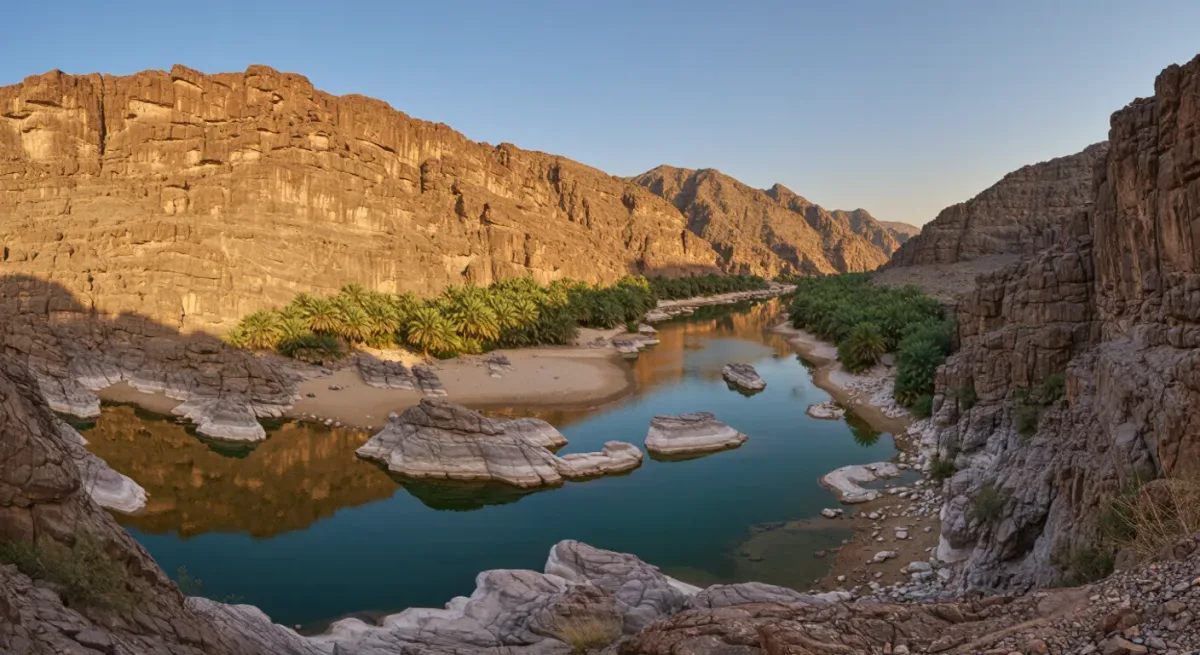
East of the interior, the Hajar foothills drop into wadis, canyons with permanent water, that anchor Oman's outdoor tourism. Wadi Shab is the classic: a 40-minute walk up a canyon to a swim through a keyhole into a hidden waterfall chamber, with a short boat crossing at the trailhead costing a couple of rials. Wadi Bani Khalid is the gentler alternative, with pools reached minutes from parking and palm-shaded picnicking. Bimmah Sinkhole, on the coastal road toward Sur, is a collapsed limestone chamber with turquoise water and basic facilities. Two safety rules govern all of them: never enter any wadi when rain has fallen anywhere upstream, because flash floods arrive faster than clouds suggest, and treat wet rock as the main hazard, not distance.
Jebel Akhdar and Jebel Shams
The high plateau of Jebel Akhdar, around 2,000 meters, is the terraced-pomegranate heart of the mountain interior, reached by a checkpoint road that requires a competent driver and, in practice, a vehicle with reasonable clearance. Ottoman-scale views open at Wakan and the abandoned village settlements along the rim paths; Oman's highest summit area, Jebel Shams, holds the Grand Canyon of Arabia, the Wadi Ghul rim walk, a genuine cliff-edge trail for which early starts and a guide make sense. Mountain temperatures run 10 to 15 degrees cooler than the coast, which makes the plateau the natural summer refuge as well as the winter hiking base. Accommodation on the plateau skews to quality resorts that book out weeks ahead in season.
Salalah and the khareef
The Dhofar region around Salalah, a two-hour flight or a two-day drive south, inverts Oman's calendar. From late June to late September the Indian Ocean monsoon, the khareef, drapes the Dhofar hills in fog and turns them green, dropping temperatures into the twenties while the rest of the Arabian Peninsula sits above 45 degrees. The season brings domestic Gulf tourism at full volume, fog-dripping frankincense-trail sites such as Wadi Dawkah and Job's Tomb in the mountains, and busy beaches at Al Mughsail where the monsoon surf closes swimming. October to March is the quieter alternative, with clear skies, archaeology at Sumhuram and Al-Baleed, and the lowest humidity on the Arabian Sea coast.
| Stop | Allow | Best months | Notes |
|---|---|---|---|
| Muscat mosque and souq | 1–2 days | Oct–Mar | Mosque open weekday mornings only |
| Nizwa, Bahla, Jabrin | 1–2 days | Oct–Apr | Friday goat market in Nizwa |
| Wadi Shab / Bani Khalid | 1 day | Oct–Apr | Flash-flood rule applies |
| Jebel Akhdar / Shams | 1–2 days | Sep–May | Clearance vehicle; cool nights |
| Salalah | 3–4 days | Jun–Sep khareef; Oct–Mar quiet | Domestic peak in monsoon |
Practical notes
- Roads: main routes are expressway-grade; wadi approaches and mountain roads want clearance and confidence. Rent from Muscat airport with insurance terms read closely for wadi driving.
- Season: October to March for everything in the north; interior summer days exceed 45 degrees.
- Money: cards work widely; carry rials for fort gates, boats and mountain stalls.
- Dress: modest clothing is the working norm everywhere outside hotel grounds, and it matters at mosques and rural souqs.
- Guides: licensed mountain guides operate from Nizwa and Muscat for Jebel Shams rim walks and canyon descents.
Two itineraries that work
For a one-week northern loop, fly into Muscat and take two nights for the mosque, Mutrah and the old city, drive to Nizwa for the fort and Friday market with a Jabrin stop, overnight in Nizwa or on the plateau, descend to Wadi Bani Khalid and the coast toward Sur with turtles at Ras al Jinz as the option, and return along the coast road through Bimmah and the Muscat outskirts. For ten days, add two plateau nights in Jebel Akhdar with the rim villages, and give Wadi Shab its own early-morning start from a Sur or Tiwi base. Travelers combining north and Salalah should treat them as separate trips stitched by the two-hour flight; driving the full country is a two-week project with long empty stages. In every version, build slack into wadi days: the stops are few, the walking is slower than the distances suggest, and the standard complaint of Oman travelers is not the roads but the rushed itinerary they imposed on themselves.
For a desert-country counterpart with the same inverted-day logic, see our Luxor site guide, and browse the travel and heritage section for more of the region.