Petra sits in the mountains above the town of Wadi Musa, roughly three hours by road south of Amman, and it rewards planning more than almost any other site in the Middle East. The Petra Archaeological Park covers around 264 square kilometers of carved Nabataean facades, Roman-era streets and hiking trails, and the difference between a rushed six hours and a well-paced two days is the difference between seeing one monument and understanding a city.
Here is the practical baseline: a one-day ticket costs 50 Jordanian dinars for foreign visitors who stay overnight in Jordan, the park opens around 6:30 a.m., and the core walk from the Visitor Centre through the Siq to the Treasury takes about 50 minutes each way on foot (Petra Development and Tourism Region Authority, visitpetra.jo).
Tickets and the Jordan Pass
Petra's fees are tiered by how long you stay in the country, which is the detail most first-time visitors miss. Travelers who can show an overnight stay in Jordan pay 50 dinars for one day, 55 for two days and 60 for three. Day-trippers arriving from Aqaba or on a cruise-style itinerary without an overnight stay pay 90 dinars, which is why an inexpensive night in Wadi Musa effectively pays for itself.
| Ticket | Price (JD) | Notes |
|---|---|---|
| 1-day, overnight visitors | 50 | Standard tourist ticket |
| 2-day | 55 | Best fit for most travelers |
| 3-day | 60 | Adds hiking trails at leisure |
| Day visitor, no overnight stay | 90 | Applies to same-day departures |
| Petra by Night | 17 | Separate ticket, selected evenings |
The Jordan Pass, sold at jordanpass.jo, bundles more than 40 state-run sites including Petra and waives the 40-dinar visa fee for travelers who spend at least three nights in Jordan. The entry tier, Jordan Wanderer, costs 70 dinars and covers a one-day Petra entry, so for most it beats buying a visa and a ticket separately. Buy the pass before you apply for the visa to claim the waiver.
The core walk: Siq, Treasury and the valley
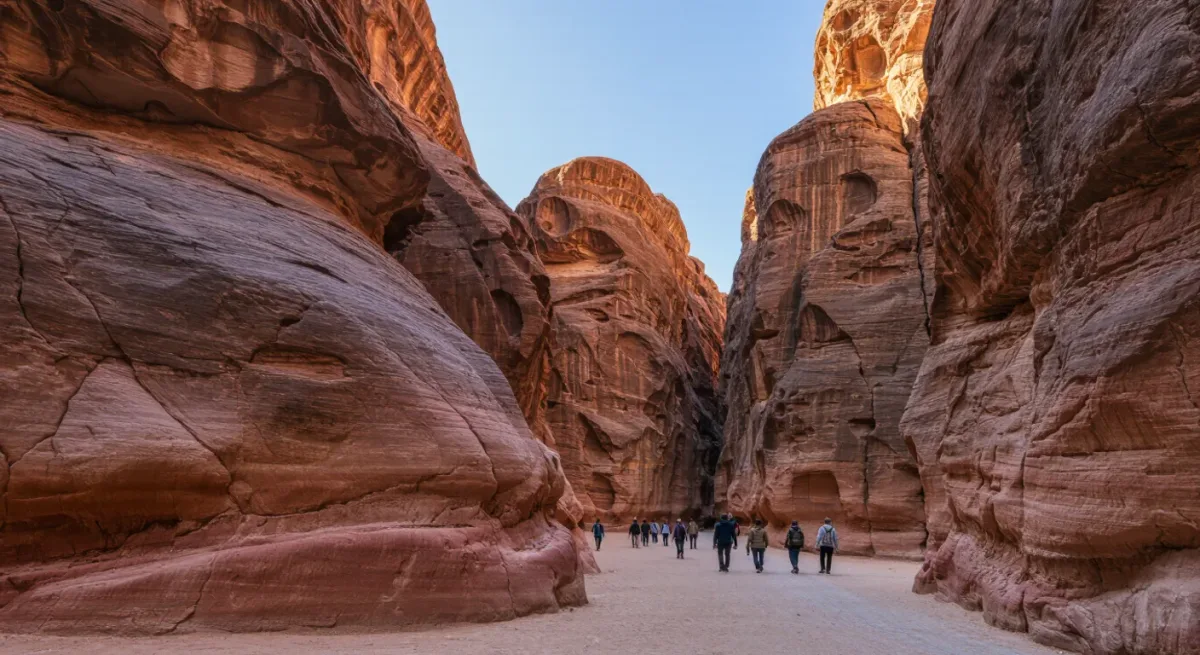
The park's main route is unambiguous. From the Visitor Centre a paved path runs about 1.2 kilometers to the entrance of the Siq, the narrow gorge that served as the city's controlled waterway and front door. The Siq itself is a flat 1.2-kilometer passage between walls that reach roughly 80 meters, and it ends at the Treasury, the Hellenistic facade that appears on most Jordanian tourism material.
What surprises many visitors is that the Treasury is the beginning, not the climax. Beyond it the valley opens into the Street of Facades, the Roman theatre carved into the hillside, the royal tombs along the cliff face and the colonnaded street that anchored the city's commercial core. Walking to the far end of the main valley and back from the Treasury takes most people two to three unhurried hours.
The Monastery and the harder trails
The Ad-Deir, or Monastery, is Petra's largest carved facade and it sits about an hour's climb above the valley floor, reached by roughly 800 rock-cut steps. The trailhead sits behind the Basin restaurant area, donkeys are available at set rates posted by the park, and anyone with knee trouble or heat sensitivity should treat the steps with respect in summer. The view from the top across the Wadi Araba mountains is the payoff.
Two further routes extend the day. The High Place of Sacrifice loop climbs to a Nabataean ritual platform with wide views and drops back through the Garden Temple complex, and Little Petra, the free satellite site of Siq al-Barid about 8 kilometers north, holds painted Binnacle-era dining halls and rarely has queues. If you hold a multi-day ticket, Little Petra works well as a lighter second or third morning.
Petra by Night
On selected evenings the Siq and the space before the Treasury are lined with paper lanterns, and visitors walk the gorge after dark to a short musical performance. The experience runs about two hours, costs 17 dinars on top of day entry, and is booked at the Visitor Centre or through petrabynight.jo. It does not replace a daytime visit; the carvings read very differently by flame and by daylight, and most travelers who do both treat the night walk as a supplement.
Seasons, heat and daylight
Petra sits at around 900 meters above sea level, which gives it colder winters and milder summers than the Dead Sea or Aqaba. The comfortable core season runs from October through April. In July and August midday temperatures regularly pass 35 degrees Celsius on the valley floor, and rangers advise starting at opening time, resting through midday and returning to the trails after 4 p.m. Winter brings short rain spells that can close the Siq briefly during flash-flood warnings, and January mornings can sit near freezing at the trailheads.
Check operating notes before you travel in our season-by-season guide to Jordan, and see the rest of our reporting in the travel and heritage section.
Practical details
- Getting there: Wadi Musa is about three hours from Amman on the Desert Highway, 1.5 hours from Aqaba, and reachable by JETT bus, private transfer or rental car. Parking sits 2 kilometers from the Visitor Centre, with a shuttle between the two.
- Hours: the park opens around 6:30 a.m. with seasonal closing between roughly 4 p.m. in winter and 6 p.m. in summer; last entry is earlier than closing.
- Guides: licensed guides are hired at the Visitor Centre for half- and full-day rates; multilingual coverage is widest in the morning.
- Cash and cards: ticket offices accept cards, but stalls inside the park and taxis in Wadi Musa work better with cash dinars.
- What to carry: more water than feels reasonable, closed shoes with grip, sun protection and layers between October and March.
Two days remains the standard recommendation: one for the main valley and the Monastery, one for the quieter trails and Little Petra. Travelers who compress Petra into a single day should enter at opening, walk straight through the Siq before the crowds build and save the climb for the cooler hours of the afternoon.