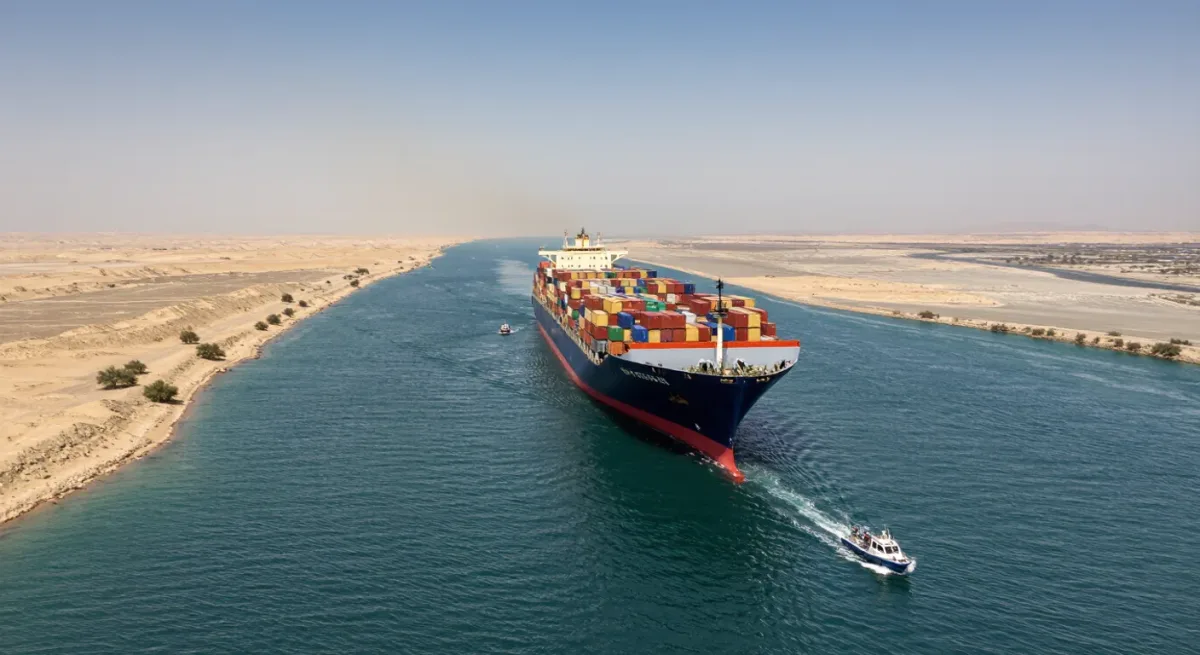
The world's container shipping is finding its way back to the Suez Canal. In mid-August, Maersk and Hapag-Lloyd moved another major Asia-Europe container service back through the canal under their Gemini network partnership, and the CMA CGM Jacques Saade, one of the largest container ships afloat, transited Suez for the first time in two years, as Red Sea route capacity surged by roughly 184 percent with the major lines' resumed sailings (Euronews, August 14, 2026; industry tracking).
The return is the market's verdict on the corridor's changing risk math: the Saudi-led maritime coalition formed at the end of July, the pause in the worst of the strikes, and war-risk insurance terms that, while still elevated, have crossed back below the cost of the Cape of Good Hope reroute for enough sailings to flip the economics. For an industry that has spent more than two years and billions of dollars in extra fuel and time going around Africa, the shift is the beginning of normalization, with emphasis on the beginning.
What is actually back
The specifics matter because headlines outrun fleets. What has returned is a subset of services: the Maersk-Hapag-Lloyd Gemini network sailings, Middle East to US East Coast routes and now another Asia-Europe string, chosen vessel by vessel and week by week against insurance pricing, escort availability and the security situation at Bab el-Mandeb. The capacity surge of roughly 184 percent in August is measured from the war's trough, when Red Sea capacity had collapsed to a fraction of normal, so the corridor is recovering toward half its former share rather than retaking it. The Jacques Saade's transit is the symbolic marker: the 23,000-TEU class ships that anchor Asia-Europe trade had been the first withdrawn and are the last to trust a corridor's return.
| Marker | Status, mid-August 2026 |
|---|---|
| Maersk-Hapag-Lloyd services via Suez | Another Asia-Europe string restored |
| Largest vessels | CMA CGM Jacques Saade transits for first time in two years |
| Red Sea capacity | ~184% above war-trough levels |
| Full industry return | Explicitly distant, lines caution |
The economics that flipped
The reroute arithmetic is brutal and simple: around Cape of Good Hope adds roughly ten to fourteen days to an Asia-Europe round trip, burning additional fuel per day and tying up vessel capacity that would otherwise carry boxes. Through the crisis, war-risk premiums on the Red Sea made the Cape the rational default. The summer's combination, coalition escort architecture, the strike pause, and the partial de-escalation in the naval standoff around Hormuz, has pulled those premiums down for carefully chosen sailings, and every service that returns releases vessels and capacity back into a network that has been running stretched. The consequences are already visible in the freight-rate market: Asia to US East Coast rates, which had soared through the disruption, are easing as capacity loosens, while the canal's own receipts begin their recovery from the trough that has cost Egypt billions in foreign currency.
What still holds the corridor back
- Hormuz: the Gulf-side chokepoint remains effectively closed to routine traffic, so Asia-Gulf legs and the LNG trade stay disrupted even as the Egypt-Yemen corridor reopens.
- Insurance: war-risk cover for Red Sea transits prices the tail risk of the war restarting, not just its current state; one incident reprices the book.
- Confidence schedules: lines plan networks months ahead; a corridor needs a season of quiet, not a fortnight, before the timetable builders commit.
- The land threat: the Houthi arsenal on the Yemeni coast remains in place; the coalition patrols the sea, not the launch sites.
The stakes for Egypt and the region
For Egypt, the returning strings are the first visible turnaround in the canal's two-year depression, the revenue pillar whose collapse forced the state's wartime austerity. Every restored service compounds: transit fees paid in hard currency, the Suez fleet's ancillary earnings, and the multiplier through the ports economy. For the region more broadly, the return re-validates the corridor's infrastructure, the Saudi coalition's mission, and the logic of the reconstruction now being scoped around a functioning waterway. And for global trade, it begins the unwinding of the inflation wedge the crisis pushed into every supply chain, the small print behind consumer prices from Rotterdam to Chicago.
What the schedules say next
Carrier scheduling, the industry's real-time diary, tells the forward story better than any statement. The published networks for the weeks ahead show a cautiously rising Suez allocation, with the Gemini alliance's strings and the French carrier's independent services holding corridor slots while blanking options remain loaded for quick reversal, the shipping equivalent of a theater keeping the understudy ready. Eastbound transits, ballasting toward Asia's load ports, run ahead of westbound commitments in the recovery sequence, which is why canal observers count the empty returns as the confidence indicator. The rate market's structure has shifted accordingly, the extreme war-spike premiums easing into a band that still prices risk but no longer prices impossibility, and the forward-freight agreements, where shippers hedge, have begun quoting corridor-contingent curves for the first time since the crisis began. The industry's stated consensus, that a full return needs a season of quiet, is exactly what the schedule files show: capacity returning at the pace insurance renews, which is to say, proof demanded monthly and granted weekly.
The canal authority, for its part, has resumed the pricing toolkit it used through the crisis, incentive rebates for returning lines and priority transit windows, instruments designed to convert cautious strings into committed ones as the corridor's quiet season extends.
For the supply-side counterpart to this story, read our report on OPEC+ completing its voluntary-cuts rollback, and browse the world news section for continuing coverage.