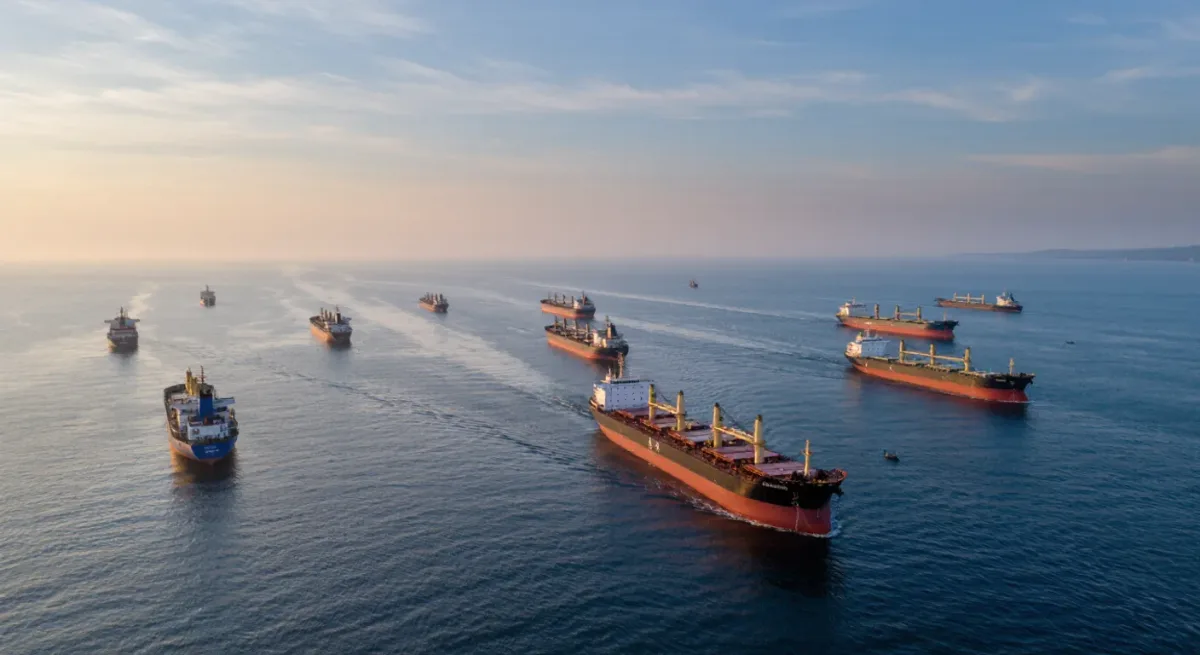
The Strait of Hormuz remains effectively closed to routine commercial shipping more than six months after Iran's February 28 closure declaration, with tracking data through mid-September showing single-digit daily transits, eight ships on September 13 against a peacetime norm of roughly 85, against the backdrop of a corridor declared completely open by the United States while its naval blockade remains in force (live transit tracking; the Guardian's war timeline).
The number is the war's quietest headline and its most consequential. Every element of the year's economic story, the oil band near 90 dollars, Europe's 13-year-low gas storage, the Suez recovery's fragility, the regional growth collapse the IMF tallied, prices back from the strait's unresolved status, and the status is written daily in the transit count: a corridor open to a few inspected, insured-at-extreme-premium, specially arranged passages is not open in any sense the world economy recognizes.
Anatomy of a closed strait
The strait's six months divide into phases. The closure declaration and the war's opening weeks: traffic collapsed toward zero as war-risk insurance priced the corridor out of the market. The early-summer truce window: a dozen-plus tankers tested the corridor, including Saudi crude carriers, Iranian vessels and Qatar's first shipment since the war began, the brief reopening the tanker trackers recorded before attacks strained the truce into a near-standstill by early July. The late-July strike pause: strikes stopped, the blockade posture continued, and transits settled at the handful-per-day level the trackers now record, an equilibrium of inspected exceptions rather than restored commerce.
| Phase | Traffic |
|---|---|
| Closure and war (Mar-May) | Near zero |
| Early-summer truce window | A dozen-plus tankers tested |
| Truce strain (early Jul) | Near standstill |
| Pause equilibrium (now) | ~8 transits/day vs ~85 normal |
What runs and what does not
The traffic that moves through the pause-era strait falls into categories: vessels operating under explicit arrangements with the enforcing navies, inspection regimes made visible at the anchorage; Gulf-destined and Gulf-originating traffic with no alternative, moving at insurance costs only strategic cargo can carry; and the periodic Iranian exports that function as the blockade's negotiated exception. What does not move is the base load: the crude and LNG carriers that in peacetime moved a fifth of the world's oil and a quarter of its LNG through the corridor, and whose absence is the physical fact beneath every elevated price in the year's markets.
The reopening playbook nobody trusts
Shipping's professionals have spent the pause preparing for a reopening they will believe when they see it. The analysis through the year, from tanker-tracking houses to the trade's own press, converges: traffic can recover quickly once transits are safe and insurable, Kpler and its peers project rapid initial recovery, but the pre-war norm requires the insurance market to reprice the corridor's tail risk, navies to stand down enforcement friction and charterers to rebuild schedule confidence, each of which follows the others with a lag. The experience of the Red Sea is the template the market now applies: even there, with the Saudi-led coalition escorting and the major lines returning services, the industry's own caution has kept capacity well below the pre-crisis share. Hormuz's reopening, when it comes, will be slower than its closure was, and the trackers will record it the way they record everything else, ship by ship.
The stakes through the winter
The transit count's next chapters are set by the diplomacy's calendar: the UN General Assembly's season, the American midterms' verdict on the war's conduct, the quota-framework negotiation OPEC+ has opened, and the European heating season that gives the strait's status a thermometer. A settlement that restores routine transits would unwind the year's price structures faster than most forecasts price, the downside risk every oil analyst now flags; a collapse of the pause would send the corridor back toward the war's opening arithmetic, the upside risk the same analysts cannot exclude. Between them, the eight ships a day keep moving, and the world's most important waterway keeps waiting for its adjective, open or blockaded, to be resolved into a single word that shipping can schedule against.
The counterfactual economists now price
The transit count's stagnation has produced a parallel literature on what a reopening would be worth. Tanker-tracking and trading-house analyses through the pause converge on the sequence: initial transits recovering within weeks as insurers reprice, the stored and delayed cargoes clearing first, and the pre-war flow pattern rebuilding over quarters as schedule confidence returns, the Red Sea's partial return providing the template and the cautionary tale at once. The macro effects are symmetric to the war's: the premium the strait's closure built into oil, gas and freight would unwind at the speed the market reprices risk, a disinflation impulse for every importing economy and a revenue haircut for the exporters, with the European gas market the most sensitive single system. None of which moves the eight ships. The corridor's status has become the year's standing reminder that the world economy's most important infrastructure is measured not in monuments but in daily crossings, and that the number, published by the trackers every day, is the war's most concise scoreboard.
The tracker's daily publish, for all its simplicity, has become the year's most consulted single number outside the oil price itself, quoted in ministers' testimony, analysts' notes and now, routinely, in the region's morning business bulletins.
For the declaration at the center of that ambiguity, read our report on the strait declared open while the blockade stays, and browse the world news section for continuing coverage.